Hungary’s new government, led by Prime Minister Péter Magyar, is eliminating the Társasági Adó (TAO) tax scheme, which for years provided the country’s soccer clubs with billions in funding. The reform, which will take effect on January 1, 2027, will force powerhouses such as Ferencváros and the Puskás Academy to significantly cut their budgets and may affect Ukrainian players, who currently make up the largest group of foreign players in the top tier of Hungarian soccer.
Sport.ua reports on the scale of changes in the sports policy of a neighboring country.
The End of the TAO Era and a Blow to the Top Clubs
During the tenure of former Prime Minister Viktor Orbán, Hungarian soccer flourished thanks to the TAO tax incentive program, which allowed businesses to direct a portion of their corporate taxes directly to sports clubs instead of the state budget. According to the current government, during the program’s run, soccer clubs received approximately 677 billion forints (over 2 billion euros), with an additional 160 million euros coming in as direct government subsidies and sponsorship funds.
A significant portion of these funds ended up in clubs close to Orbán—in particular, the “Puskás Academy” in his native village of Felcsút, which received approximately 123 million euros under the old schemes. The club itself rejects accusations of a lack of transparency, emphasizing that the investments were used to build a talent pool.
Peter Magyar called the TAO system “complex, opaque, and corrupt” and announced a drastic overhaul of the rules:
- Elimination of tax breaks starting in 2027: Instead of the old system, the government will allocate 150 billion forints (about 415 million euros) from the state budget to support team sports, with an emphasis on youth soccer rather than on retaining expensive foreign players.
- Ban on Holding Multiple Positions: A new bill would prohibit ministers, members of parliament, and party leaders from heading sports clubs and federations. As a result, Gábor Kubatov, head of Ferencváros, and Tamás Deutsch, president of MTK, may lose their positions.
- Contract Review and Investigation: The state-owned energy group MVM is already reviewing its sponsorship agreement with Ferencváros (previously valued at 12 million euros per year). In addition, the Hungarian Ministry of the Interior has accused the Budapest club of misusing 70 million euros allocated for the construction of sports facilities, and reports have appeared in the media about the club’s plans to cut the salaries of its starting players by 30%.
Financial difficulties have already affected other teams as well: three-time Hungarian champion Videoton Fehérvár, which was relegated to the second division and sold by István Garanci, a businessman close to Orbán, to the municipality for a symbolic 1 forint, is urgently seeking 2 million euros to cover its budget deficit through mid-2027.
Why this is important for Ukrainian soccer
The current season of the Hungarian top division has set a record for Ukrainian representation—there are 10 Ukrainian soccer players competing in the local league. That’s more than the number of Brazilians (9), Nigerians (9), Serbs (7), or Bosnians (7). Among the best-known Ukrainians in the league are 21-year-old “Zalaegerszeg” midfielder Danylo Krevsun and 32-year-old “Puskas Academy” midfielder Artem Favorov (who is currently recovering from a knee injury, while his club is battling for the championship against Ferencváros and defending champion Dió).
Since the new funding model focuses on youth sports and reducing spending on expensive foreign players, Hungarian clubs will have to reevaluate their personnel policies and live within their means. Despite some successes (notably Ferencváros’s four wins at the start of the Europa League group stage and the hosting of European Cup finals at Puskás Arena in 2023 and 2026), the billions poured in during the Orbán era failed to qualify the Hungarian national team for the World Cup or solve the problem of half-empty stands at the new stadiums.
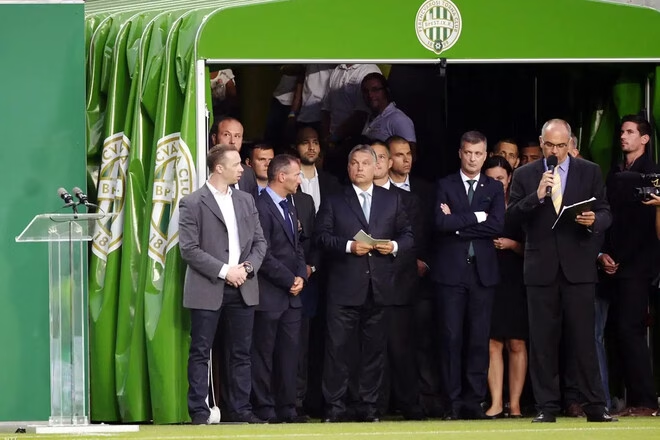
Photo: FC Ferencváros. Viktor Orbán at the opening of the Ferencváros
stadium