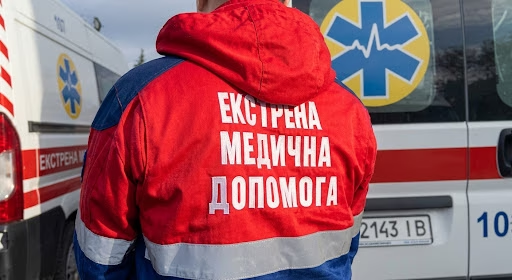
Every day, the Transcarpathian Emergency Medical Services dispatch center receives hundreds of calls. Behind each one lies someone’s pain, fear, and hope for a quick rescue. Journalists from the regional media outlet “Zakarpattia Visnyk” visited the Zakarpattia Center for Emergency Medical Care and Disaster Medicine, of the Transcarpathian Regional Council to see firsthand how the work of ambulance medics is organized from the inside and what challenges they face every day.
106 teams and up to 800 calls per day
According to Anatoliy Pshenychny, director of the Transcarpathian Regional Center for Emergency Medical Care and Disaster Medicine, 106 teams are currently on call around the clock in the region, stationed at 64 bases, stations, and substations.
- Daily call volume: Lines 103 and 112 receive an average of 650 to 800 calls.
- Annual statistics: Medical professionals make 150,000–170,000 house calls each year—to local residents as well as to tourists and visitors to the region.
Rescue begins with the dispatcher
The first stage of the fight for life takes place even before the ambulance leaves—in the dispatch center. It is the dispatcher’s job to assess the situation in a matter of seconds, determine the urgency level, and dispatch the nearest crew.
A dispatch service specialist emphasizes: the most important thing for someone calling 103 is not to panic, not to hang up first, and to provide the address and the victim’s condition as accurately as possible. Often, when under stress, people mix up house numbers or street names, forcing medical personnel to waste critical minutes searching for the location. Another problem is exaggerating symptoms to “speed up the response,” which causes the crew to respond to a non-emergency call while someone nearby is in critical condition.
If necessary, the dispatcher stays in contact with the caller until medical personnel arrive, providing step-by-step instructions on how to stop massive bleeding or perform CPR. Often, it is these telephone instructions that save patients’ lives even before the ambulance arrives.
Barriers, cluttered courtyards, and tree branches: the main obstacles doctors face
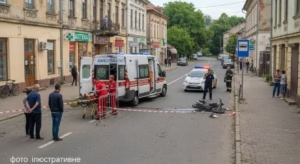
Emergency medicine physician Volodymyr Sabov says that, on average, each team handles about 8–10 calls per shift (more than 270 per month). The ambulances are fully stocked with the necessary medications and modern equipment, and mutual support within the team helps them cope with the frantic pace and lack of sleep.
However, even the most efficient team often loses time right outside the patient’s home. The doctor is reaching out to residents of the region and heads of homeowners’ associations with several important requests:
- Ensure access through the barriers. Many high-rise buildings are installing barriers en masse in their surrounding areas, to which maintenance crews do not have keys or remote controls.
- Trim low-hanging tree branches in yards. An ambulance is a large vehicle with flashing lights on the roof, which are often damaged by branches.
- Park responsibly. Passenger cars left in narrow driveways prevent vehicles from pulling up directly to the building entrance, which significantly complicates and delays the transport of critically ill patients on stretchers.
- Assist with patient transport. Many teams include women—a doctor and a paramedic—and a single driver physically cannot carry a heavy person down from an upper floor on their own. Family members should ask neighbors or passersby for help in advance.
Carpathian Specifics and Fleet Modernization
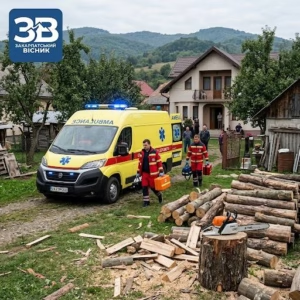
According to state regulations, a crew must arrive at critical calls within 10 minutes and at emergency calls within 20 minutes. As Anatoliy Pshenychnyi notes, the region operates under the principle of extraterritoriality: the nearest available crew responds to a call regardless of district or community boundaries. Despite this, in about 10% of critical cases and 5% of emergency cases, the response time cannot be met due to the challenging mountainous terrain, the condition of roads in remote villages, and winter weather. There are instances when a single trip to the mountains—from the moment the call is received until the patient is hospitalized—takes more than 11 hours.
At the same time, the system requires constant reinforcement of its resources: due to the highly dynamic nature of its operations and the aging workforce, there is a need for young personnel, and approximately 60 vehicles in the fleet—which have already covered 250,000–300,000 kilometers—require scheduled replacement.
Training for Medical Professionals and Civilians: Three Basic Life-Saving Skills
The center’s training department operates continuously, where emergency medical technicians practice rescue protocols for adults and children every day and undergo regular three-year retraining. In addition, instructors conduct courses for civilians and emergency service personnel—the demand for such training is so high that there are significantly more applicants than available spots.
Eduard Gorzov, head of the training department, named three key first-aid skills that every Ukrainian should possess in wartime:
- Stopping external bleeding (using tourniquets, packing, and pressure bandages).
- Performing cardiopulmonary resuscitation (chest compressions before medical personnel arrive significantly increase the chances of survival).
- The correct procedure for calling 103 involves clearly understanding when emergency assistance is needed and being able to quickly provide the dispatcher with precise coordinates and a description of the person’s condition.
The editorial staff of the regional media outlet “Zakarpats’kyi Visnyk” would like to express its sincere gratitude to the management and the entire team at the Zakarpats’kyi Center for Emergency Medical Care and Disaster Medicine for their openness, cooperation, and the opportunity to show viewers the inner workings of the service. Thank you for your daily work and for the lives you have saved!