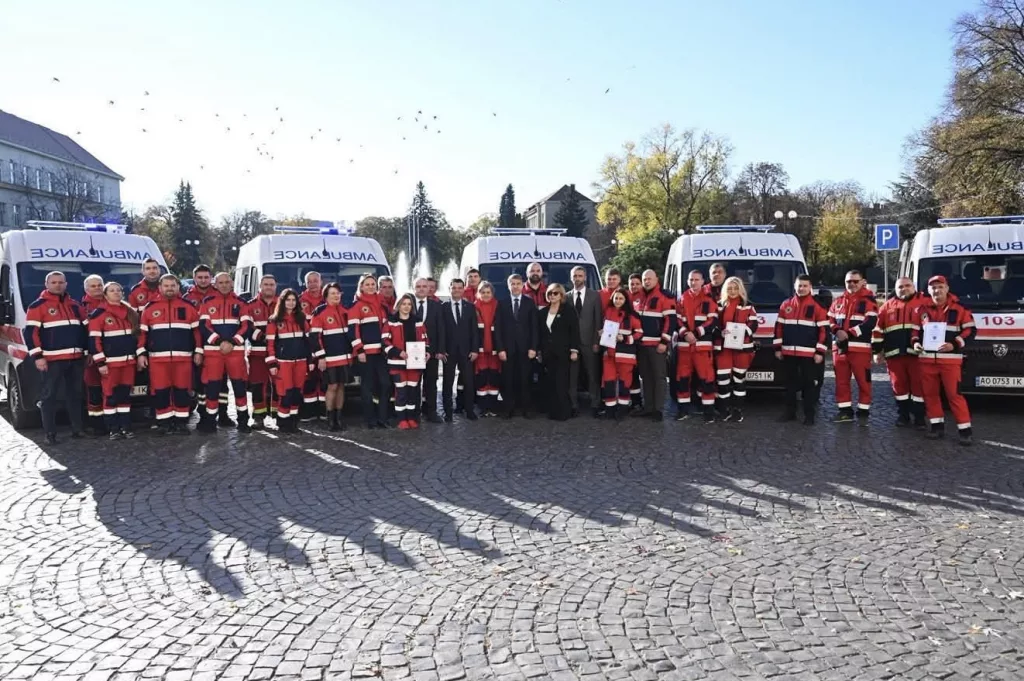
The vehicle fleet of the Transcarpathian Center for Emergency Medical Care and Disaster Medicine has received a significant boost—eight new, modern, specialized Type B ambulances. These high-mobility vehicles are designed to significantly reduce the time it takes for medical teams to reach patients, particularly in mountainous areas with challenging logistics.
The keys and certificates for the vehicles were ceremonially handed over to the medical staff by Myroslav Biletskyi, head of the Transcarpathian Regional State Administration, together with the leadership of the regional council and relevant services.
Myroslav Biletsky on Round-the-Clock Duty and Wartime Challenges
Miroslav Zoltanovich Biletsky, Head of the Transcarpathian Regional State Administration, served as the keynote speaker at the event and emphasized the strategic importance of modernizing emergency medical transport during wartime:
“The emergency medical service is an institution that maintains the region’s medical response 24/7. Every year, our teams cover nearly 3.3 million kilometers of roads and respond to over 150,000 calls. Behind each of these figures are human lives saved.
During the war, the workload has increased significantly: our specialists not only respond to calls from community residents but also conduct medical evacuations, stand by when evacuation trains arrive, and provide emergency care to veterans and internally displaced persons. Given the winter season and the terrain of Zakarpattia, reaching mountain villages is extremely difficult. Therefore, having modern all-wheel-drive ambulances equipped with state-of-the-art equipment literally determines a person’s fate on the road.”
Myroslav Biletsky also thanked all doctors, medical assistants, paramedics, and drivers for their dedicated work and outlined the service’s future prospects: Currently, the region’s total fleet consists of 150 vehicles, of which about 60 need to be replaced due to severe wear and tear. As early as next year, they plan to meet at least half of this need—by acquiring 17 vehicles through the Carpathian Initiative programs and purchasing another 10 or so vehicles using local budget funds.
A First for Ukraine and Joint Funding
The head of the Regional State Administration highlighted the exemplary cooperation between the medical facility and regional authorities, which made it possible to carry out the upgrades without directly using funds from the state budget:
- The Emergency Medical Care Center purchased 5 vehicles directly using its own special-purpose funds, which were saved through effective internal management;
- Three vehicles were purchased using funds from the regional budget, from which deputies allocated 3.6 million hryvnias.
Other participants at the event commented on this experience, which is unique for the country:
- Roman Dmytrovych Saray, Chairman of the Transcarpathian Regional Council, noted that this is the first instance in Ukraine where ambulances have been purchased using funds from the regional budget and the medical facility itself: “Thanks to the persistence and managerial skills of the Center’s director, Anatoliy Pshenychny, funds were saved for the first five vehicles. This encouraged the regional council and the Regional State Administration to get involved and provide additional funding for three more vehicles.”
- Anatoliy Oleksandrovych Pshenychny, Director of the Transcarpathian Center for Emergency Medical Care and Disaster Medicine (a public non-profit enterprise under the Transcarpathian Regional Council), emphasized the high technical standards of the new vehicles: “The cost of a single vehicle is approximately 3.5 million hryvnias. These are true ambulances on wheels, equipped with patient monitoring devices, oxygen stations, and everything necessary to provide full medical care while on the move. They will replace vehicles whose combined mileage has exceeded 2.5 million km.”
- Lyubov Ivanivna Mandzich, Director of the Health Department of the Transcarpathian Regional State Administration, added: “These funds were not diverted from patient care expenses—they are special funds earned by the enterprise. In wartime, vehicles wear out constantly, and this kind of collaboration between the industry and local government is critically important.”
- Andriy Andriyovych Sheketa, First Deputy Chairman of the Transcarpathian Regional Council, emphasized the scope of the initiative: “Substations from Uzhok to Yasinya and from Rakhiv to Stavne received new vehicles. The collective contribution of the Transcarpathian community to the regional budget has been channeled into protecting the health of residents.”
Where the new vehicles were deployed
The specialized vehicles were sent to stations and permanent bases in eight key locations across the region:
- Rakhiv;
- Tyachiv;
- Khust;
- Irshava;
- Svalyava;
- Perechyn;
- Seredne;
- Dubove (including the settlement in the village of Stavne).