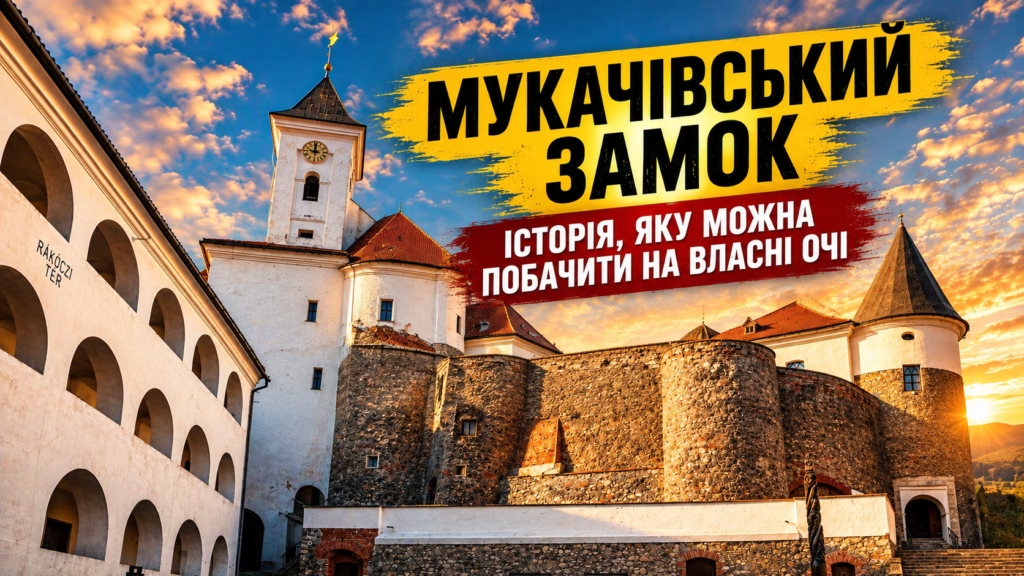
It has weathered sieges and changes in rulers; it has served as a fortress, a princely residence, a prison, and barracks, and today it is one of the most famous tourist attractions in Transcarpathia. Mukachevo’s “Palanok” Castle preserves the history of several centuries within its walls.
High above Mukachevo, on a hill of volcanic origin, stands one of Transcarpathia’s main landmarks—Palanok Castle. The castle hill rises about 68 meters above the city, and the complex itself consists of several levels—the Upper, Middle, and Lower Castles.
Today, it houses the Mukachevo Historical Museum, and visitors can explore the ancient fortifications, museum exhibits, inner courtyards, towers, and other elements of the fortification complex.
From Wooden Fortifications to a Mighty Fortress
The history of Castle Hill dates back to the Middle Ages. According to the Department of Tourism and Resorts of the Transcarpathian Regional State Administration, Slavic settlements existed in this area as early as the 6th–9th centuries, and the first fortifications were later built here.
In the 11th century, construction of stone fortifications began on the mountain. Later, the castle was rebuilt and reinforced several times, as it was of great strategic importance and controlled trade and military routes.
One of the castle’s most famous rulers was Prince Fedir Koriatovych of Podolia, who acquired Mukachevo at the end of the 14th century. It is his name that is associated with the large-scale reconstruction of the fortress and its transformation not only into a defensive structure but also into a princely residence.
Three Years of Siege and Princess Ilona Zrini
One of the most famous chapters in the history of “Palanka” is connected with the siege of 1685–1688.
At that time, the fortress was defended by supporters of the Transylvanian Prince Imre Tekeli, led by his wife, Princess Ilona Zrini. Austrian troops kept the castle under siege for nearly three years. It is this event that has become one of the most famous chapters in the fortress’s history.
A few decades later, “Palanok” once again found itself at the center of military events. From 1703 to 1711, the castle was one of the key centers of the struggle led by Ferenc II Rákóczi against the Habsburgs. During this period, the fortress continued to be fortified, and its defensive system expanded even further.
The Fortress That Became a Prison
After the defeat of the Rákóczi uprising, the castle lost its former strategic importance. In the centuries that followed, it was used for various purposes.
Of particular interest is the period when “Palanok” was converted into a political prison. According to the Department of Tourism and Resorts of the Transcarpathian Regional State Administration, the prison operated here for over a century—until 1896. During this time, thousands of prisoners passed through its walls.
Throughout various periods of history, the castle was also used as a military facility. In the 20th century, military units were stationed here, and later the fortress began a new chapter as a historical and cultural site.
What can you see at the castle today?
Today’s “Palanok” is more than just walls and towers. The Mukachevo Historical Museum is located on the castle grounds, and its exhibits tell the story of the city, the region, and the fortress itself.
According to records, the complex has about 130 rooms, connected by a complex system of passageways and underground tunnels.
The fortress’s architecture deserves special attention. The castle is situated in a cascade on a mountainside, and its defensive structures were built over the course of various historical periods. That is why today you can see a combination of architectural styles from several eras here.
🎥 Journalistsfrom “Zakarpats’kyi Visnyk”visited Mukachevo Castle and prepared a video tour of the fortress.
In our report—the atmosphere of “Palanka,” its historical sites, museum exhibits, and the people who come here today to see one of Transcarpathia’s most famous landmarks with their own eyes.